When a factory manager asks me about solar, the first question is almost always the same: "How big a plant can we fit on our roof?" It sounds like the right question, but it is usually the wrong place to start. A solar plant sized to the roof can easily pay back more slowly than a smaller one sized to the factory itself. In this article I go through what a first feasibility look at a factory solar plant involves: the load profile, the roof or land, sizing, investment against savings, and how to think about payback.
All numbers in this article are hypothetical and only show the logic. Prices, tariffs, sunshine and rules differ from one country and one site to another, so your own numbers will be different.
Start with how the factory uses power, not with the roof
A solar plant only produces during the day, with a peak around noon. So the first thing I want to see is not the roof drawing but the factory's electricity use over a normal week: how much power is drawn on a weekday at noon, on a Friday, during a shutdown, and at night. Most factories have a daytime base load that hardly ever drops, and that base load is where solar power is worth the most, because every kilowatt-hour produced is used on site and replaces power you would otherwise buy.
The monthly bill alone is not enough for this. It tells you how much you used, not when. If you can get interval data from the meter, even for a few months, the picture becomes much clearer.
Roof or land: what is really available
Next comes space. On a roof, the useful questions are simple: how many square metres face the right way without shade from tanks, chimneys or neighbouring buildings, and can the structure carry the extra weight for 25 years. As a rough rule, every kilowatt-peak of panels needs somewhere around 6 to 10 square metres, depending on the layout. Land next to the factory is often easier to build on, but it brings its own costs: fencing, foundations and a longer cable run. And in both cases, the connection to the factory's own electrical network has to be checked early, because it can limit the size more than the space does.
Right-sizing: bigger is not always better
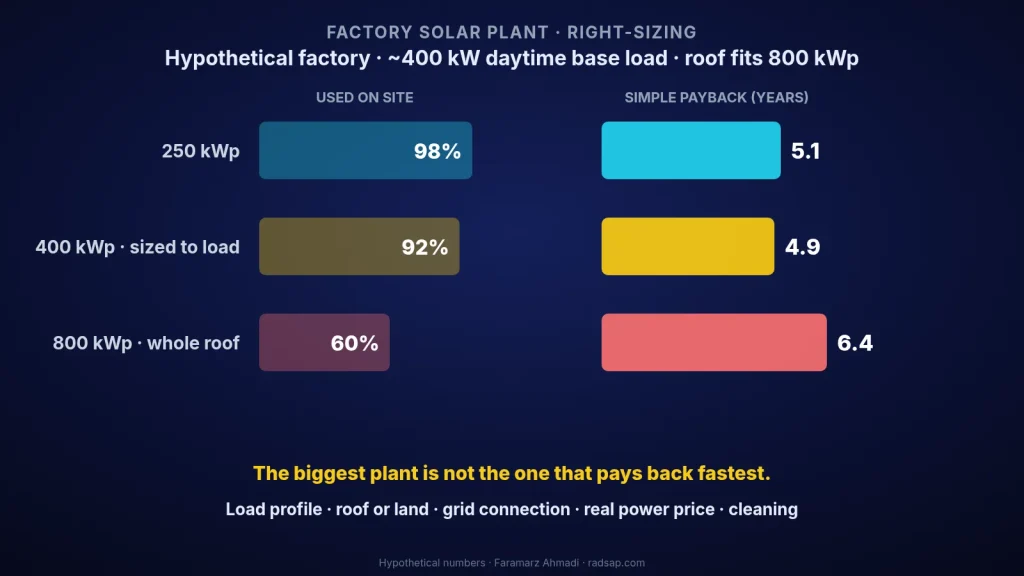
Here is where the roof-first approach goes wrong. Imagine a hypothetical factory with a daytime base load of about 400 kW and a roof that could take 800 kWp. If you fill the roof, a large part of the noon production on weekends and holidays will not be used on site. That surplus is either sent to the grid at a low price or simply lost. A plant sized closer to the base load uses almost everything it produces.
| Hypothetical option | Used on site | Investment | Net yearly saving | Simple payback |
|---|---|---|---|---|
| 250 kWp | 98% | $150k | $29k | 5.1 years |
| 400 kWp, sized to the base load | 92% | $220k | $45k | 4.9 years |
| 800 kWp, the whole roof | 60% | $416k | $65k | 6.4 years |
In this hypothetical case the full-roof plant saves the most money each year, but it pays back the slowest. Which option is "right" depends on what the company wants: the fastest payback, the largest saving, or a target share of clean energy. The point is that it should be a decision, not a side effect of the roof size.
Investment against savings: the honest version
The simple payback above is just the investment divided by the net yearly saving. It is a good first filter, but an honest look at the savings needs a few more things: the real price of the power you replace (not the average of the whole bill), the price you get for anything sent to the grid, yearly operation and cleaning costs, a small loss of panel output every year, an inverter replacement somewhere in the plant's life, and how electricity prices may change. Dust matters too: in dry, dusty areas, a plant that is not cleaned regularly can lose a noticeable part of its output.
A few first steps you can take this month
- Collect 12 months of bills and, if possible, interval data from the main meter.
- Write down the factory's working pattern: shifts, weekends, holidays and planned shutdowns.
- Mark the free, unshaded roof and land areas on a simple site plan, with the age of each roof.
- Ask what your tariff and grid rules allow: selling surplus, self-consumption only, or any incentive scheme.
With these four things on the table, a first go/no-go answer is usually possible within days, not months. It is the same one-page logic I described in the feasibility study for a manufacturing investment.
The number I check before anything else
There is one number I always work out before I even look at panel prices or the roof. Over the years it has told me, more reliably than anything else, whether a factory solar plant will be a good investment or a disappointment. It comes from the factory's own data, but how you calculate it, and what you compare it with, depends on how that factory runs. Done the wrong way, it makes almost any plant look good. That is why I prefer to work it out together, on the real data of the site.
Common mistakes
- Sizing to the roof instead of the load. The biggest plant is rarely the one with the best payback.
- Using the average bill price. Solar replaces daytime power; its value depends on that price, not the average.
- Forgetting the roof itself. An old roof that needs repair in five years should be fixed before panels go on it.
- Ignoring cleaning and dust. A dirty plant quietly loses output every month.
- Leaving the grid connection to the end. Permits and connection limits can change the size and the timeline.
For related reading: the go/no-go feasibility study behind any investment decision, why efficiency gains do not always reach profit, and the factory management dashboard where energy cost belongs.
Thinking about a solar plant for your factory?
If you want us to look at the feasibility of a solar plant for your factory together, send me your last 12 months of electricity bills, the working shifts, and a rough idea of the roof or land you have. I will tell you which size range makes sense for your load, and we can go through the numbers that really decide the payback, including the one above.
Contact me Read: go/no-go feasibility study Read: efficiency and profit
Sources
- Solar output depends on location, panel orientation, shading, temperature and soiling; yearly yield per kilowatt-peak varies widely between sites.
- Self-consumption share, the value of exported power and operation costs are standard inputs in the financial assessment of commercial and industrial solar plants.
- All numbers in this article (load, sizes, prices, savings and payback) are hypothetical and only illustrate the logic.