A while ago a friend who was starting a small production line showed me his feasibility study. 140 pages, a nice cover, chapters on market, technology, location, finance. He had found a sample online, changed the product name and filled in the tables in two weeks. He was proud of it, and honestly, it looked professional. Two weeks later he called me. The bank's expert had read it for about fifteen minutes, asked three questions, and sent it back. My friend could not answer any of the three, because the sample he copied had never asked them.
When people search for a "feasibility study sample", most of them want a file to fill in. I understand why. But in 24 years in manufacturing I have seen more investment cases fail on the questions a sample never asks than on bad numbers. In this article I explain what a feasibility study that a bank or an investor takes seriously really has to answer, why downloaded samples so often fail, and a quick self-check you can run on your own draft. The story is a composite and every number here is illustrative.
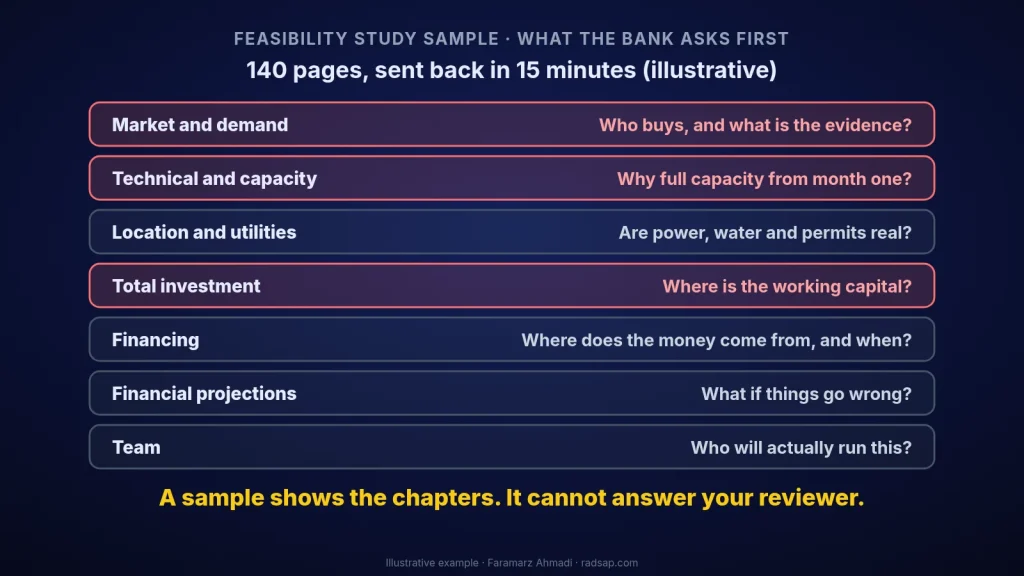
The three questions that sent 140 pages back
The expert did not argue with the layout or the chapter titles. He asked: "Where does your sales volume come from? Who has actually agreed to buy?" Then: "Your line runs at full capacity from the first month. Why?" And finally: "I don't see working capital. How will you pay for raw material for the first three months before customers pay you?" Three questions, and the whole report lost its credibility. Not because the tables were empty, but because they were not connected to anything real.
Why a downloaded sample usually fails
- It was written for another product and another year. Prices, exchange rates, wages and energy costs from the sample quietly stay in the tables.
- The chapters do not talk to each other. The market chapter says one volume, the financial tables use another, and the capacity chapter assumes a third.
- It answers the questions the author had, not the ones your reviewer has. A bank, a private investor and your own board each read a feasibility study with a different first question.
A sample is useful to see the table of contents. It is dangerous when it becomes the content.
Seven questions a bankable feasibility study must answer
Whatever the format, a reviewer is looking for clear, evidence-based answers to these seven questions. If your report answers them honestly, the chapter titles matter much less.
| Section | The question behind it | Red flag I often see |
|---|---|---|
| Market and demand | Who buys, how much, at what price, and what is the evidence? | National statistics instead of named customers or letters of intent |
| Technical and capacity | Why this capacity and this technology? | Full capacity from month one, no ramp-up |
| Location and utilities | Why here, and are power, water, permits and people really available? | Utility costs copied from another region |
| Total investment | How much money in total, not only the machines? | No working capital, no pre-operating costs |
| Financing | Where does the money come from, and when? | Loan arrives before the equity is shown |
| Financial projections | When does cash turn positive, and what if things go wrong? | One single scenario, always the optimistic one |
| Team and organization | Who will actually run this? | An organization chart with no names and no experience |
The red flag I see most: working capital
If I had to pick one gap, it is this. Almost every sample I have reviewed treats the investment as land, building and machines. But a new line also has to buy raw material, hold stock, pay salaries and wait for customers to pay. In my friend's case, an illustrative line with a $900,000 machine budget needed close to another $200,000 just to survive the first months. That money was nowhere in his 140 pages. The project was not unprofitable. It would simply have run out of cash before it had a chance to be profitable.
The second most common gap is ramp-up. No new line runs at its nameplate capacity in the first month. Operators learn, customers approve samples, and suppliers find their rhythm. A report that ignores this tells the reviewer that the author has never started up a line.
A five-minute self-check for your draft
Before you send your study to anyone, answer these honestly with yes or no:
- Can I point to a named customer, contract or letter behind my base-case sales volume?
- Does the same sales volume appear in the market chapter, the capacity chapter and the financial tables?
- Have I included working capital and the costs before production starts?
- Does my first year run below full capacity, and can I explain why?
- Have I shown at least one bad but realistic scenario next to the base case?
If you answered no to two or more, your study is not ready for a bank yet, however good it looks. For a smaller, internal decision, the one-page go/no-go in five checks is often enough, and for an energy project see the factory solar plant feasibility article.
What I keep for the work itself
These questions show you what a reviewer looks for. What makes the difference in practice is something else: the order in which I build the sections, so the numbers stay connected from the first page to the last, and one test I run on every key assumption before any bank or investor sees it. That test has saved more of my projects than any spreadsheet. It depends on your product, your market and who is going to read the report, so I do it together with the team, on the real case.
Is your feasibility study ready for the bank?
If you have a draft feasibility study, or a sample you have started filling in, and you want to know whether it will survive the first fifteen minutes with a bank expert or an investor, send it to me. I will tell you which questions it leaves open, where the numbers stop talking to each other, and what to fix before you submit it.
Contact me Read: one-page go/no-go Read: solar plant feasibility
Sources
- UNIDO, Manual for the Preparation of Industrial Feasibility Studies: the classic structure of market, technical, location, organization, investment and financial analysis.
- The story is a composite of several cases; the line, the amounts and all numbers in this article are illustrative.