Every monthly review I have sat in has the same moment. A KPI turns red, someone asks “who owns this?”, and three people start explaining why it is not really theirs. A KPI without one clear owner is just a number on a slide. In this article I show the simple ownership rules I use, a one-page KPI ownership matrix and the questions that decide who should own each KPI.
In 24 years in manufacturing I have seen plants with good dashboards and bad results, and the gap was almost never the chart. It was ownership. The number was owned by a department, by a meeting, or by whoever made the slide. The plant and all numbers below are illustrative, not data from a real company.
The illustrative plant
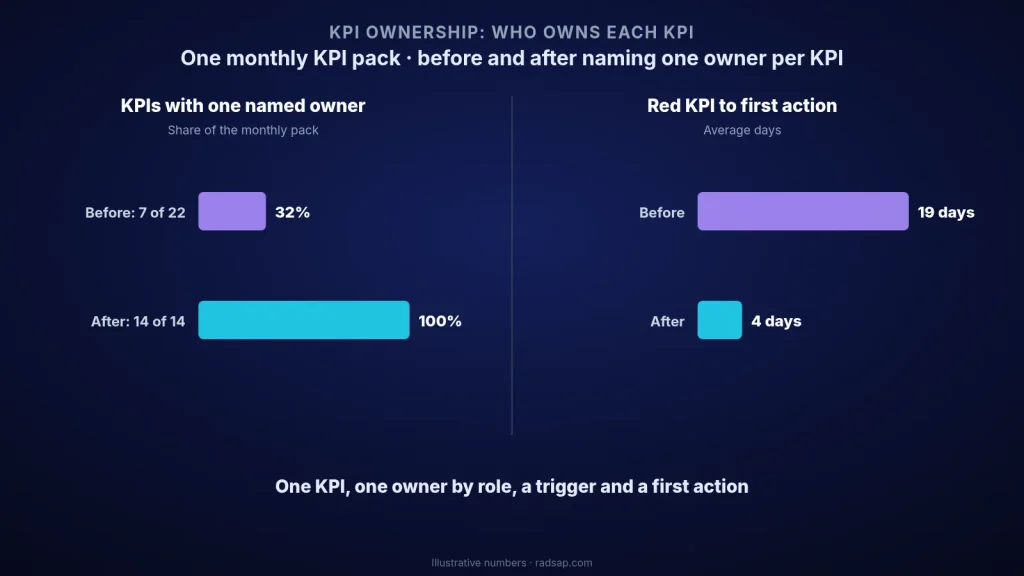
A plant has a monthly management pack with 22 KPIs. When we wrote down the owner of each one, we found this:
- 6 KPIs had no named owner at all.
- 5 were owned by “Production”, a department, not a person.
- 4 had two owners, for example scrap rate owned by both production and quality.
- Only 7 had one named role that could actually move the number.
On average, a KPI stayed red for 19 days before anyone took a first action. Not because people were lazy, but because everyone assumed someone else would act.
Who should own a KPI? Five rules I use
- One KPI, one owner. Shared ownership means no ownership. Others can contribute, but one role answers for the number in the meeting.
- The owner is a role, not a department. “Line 2 supervisor” or “maintenance lead”, not “Production”. Use the role name, so ownership survives when people change jobs.
- The owner must be able to move most of the number. My test question is simple: “If this KPI turns red on Monday, can you change it by Friday with your own people and budget?” If the answer is no, you have the wrong owner or the wrong KPI.
- Owning the number is not the same as owning the data. The person who collects and checks the data, the data steward, is often someone else. Write both names down. When the data is wrong, you know who fixes the source; when the result is bad, you know who fixes the process.
- Every KPI has a trigger and a first action. The owner agrees in advance at what value the KPI is red and what happens first: a stop-and-look on the line, a root-cause session, an escalation within 48 hours. A red KPI without a first action is only decoration.
Split compound KPIs before you assign them
Most ownership fights come from KPIs that depend on several teams. OEE is the classic case. Availability is mostly in the hands of maintenance, performance in the hands of the line, quality in the hands of the line and the quality team. If one person owns OEE alone, they spend the meeting defending, not acting.
What works better: the production manager owns OEE at the bottleneck as the result, and each part has its own owner underneath. The same applies to on-time delivery, which depends on planning, purchasing and production. Split it into schedule adherence, material availability and dispatch on time, and give each part one owner.
A one-page KPI ownership matrix
This is the format I use. One row per KPI, no more than one page for a plant.
| KPI | Owner (role) | Data steward | Red when | First action |
|---|---|---|---|---|
| OEE at the bottleneck (line 2) | Production manager | Line 2 shift leader | Below 65% for one week | Loss review at the line within 48 hours |
| Availability, line 2 | Maintenance lead | Maintenance planner | Below 85% for one week | Top three stops reviewed with the operators |
| Scrap rate, line 2 | Line 2 supervisor | Quality inspector | Above 3% for two days | Stop and check the first-piece approval |
| Schedule adherence | Planning lead | Production planner | Below 90% for one week | Root cause for each missed order in the weekly meeting |
| Material shortages | Purchasing lead | Warehouse supervisor | More than 2 stops in a week | Supplier call and a recovery date the same day |
Notice what is missing: no row says “Production” or “all managers”. And every red value has a time window, so one bad shift does not start a fire drill.
How to set it up in two weeks
- List the KPIs you really report. Take the last monthly pack and write every KPI on one sheet, with its current “owner” as people would answer today.
- Run the Monday-to-Friday test. In one meeting of about an hour, ask the test question for each KPI. Mark every KPI where nobody can say yes.
- Split, move or retire. Split compound KPIs, move the rest to the role that can act, and retire KPIs that nobody can move. They can stay on a second-level dashboard for information.
- Agree triggers and first actions with each owner. Owners set them, not the reporting team. People defend targets they did not choose.
- Change the meeting. In the monthly review, the owner of each red KPI speaks first: what happened, what they did, what help they need. Others ask questions after.
In the illustrative plant, the pack went from 22 KPIs to 14, all 14 with one named owner and a data steward. After two months, the average time from red to first action dropped from 19 days to 4. The dashboard did not change at all; only the names next to the numbers did.
Common mistakes
- Giving every KPI to the plant manager. It looks like strong leadership, but it means nobody below acts without waiting for a decision.
- Choosing owners by who reports the number. The analyst who builds the dashboard is a data steward, not an owner.
- Ownership without authority. If the owner cannot approve overtime, a spare part or a change in the plan, they own the blame, not the KPI.
- Too many KPIs per person. More than four or five KPIs for one role usually means some of them are watched, not managed.
Ownership only works when the KPI means the same thing to everyone, so I always start with the definitions, as I explained in my article on one KPI dictionary across plants. Once the owners are clear, an exception dashboard that brings bad news early becomes much more useful, because every alert lands with a person who can act. And if you are not sure where to focus first, start with the KPIs at your production bottleneck.
Want to check the ownership of your own KPIs?
Send me the KPI list from your last monthly report. We can run the Monday-to-Friday test together, build your one-page ownership matrix and agree triggers and first actions that your team can actually use.
Contact me Read: the KPI dictionary Read: exception dashboards
Sources
- The idea of one accountable owner per measure is common to most performance management approaches, including the RACI model, where only one role is “accountable” for each result.
- OEE is the product of availability, performance and quality, which is why its parts usually belong to different teams. The plant, KPIs, thresholds and all numbers in this article are illustrative only.
- Related reading on this site: the KPI dictionary, exception dashboards and finding the production bottleneck with data.