The demo looks polished. The vendor slide says “fit for manufacturing”. The licence quote arrives before anyone has written down what “done” means for your plant. That is how ERP projects burn months — and budgets — on the wrong questions.
After 24 years in manufacturing and an M.Sc. in industrial engineering, I have sat on both sides of ERP selection: as a plant planner who had to live with the system, and as someone helping factories decide what to buy. The pattern is consistent. Teams argue about modules and brands before they agree on process scope, master-data ownership and who will own the change after go-live.
This article is a practical list of 20 questions before buying an ERP. They are grouped by process and scope, data and master data, people and ownership, integration and shop floor, and cost and risk. Use them in vendor workshops. Numbers in the short table are illustrative, not a case study from a named plant.
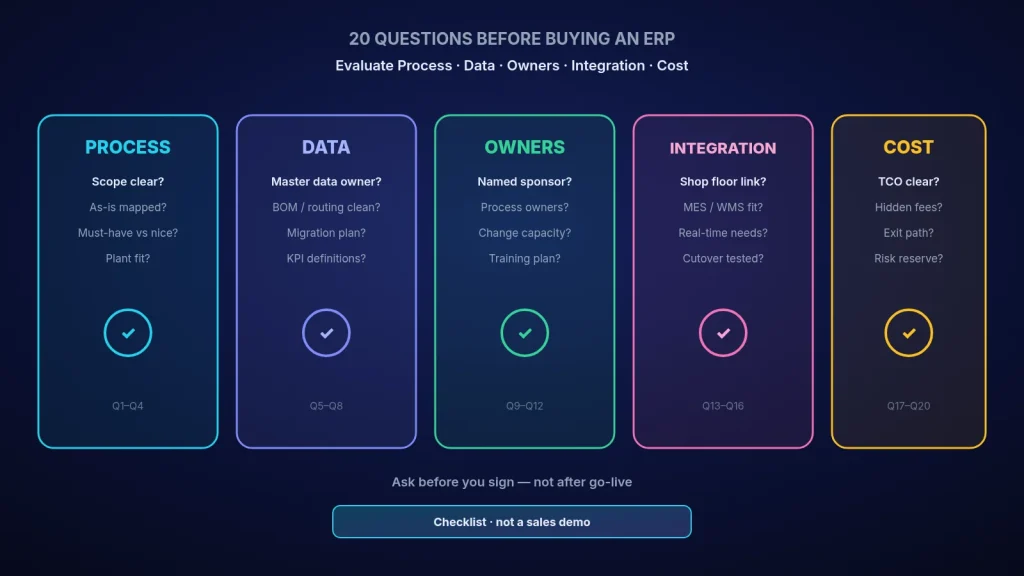
Process and scope (questions 1–4)
- Which processes are in scope for wave 1 — and which are explicitly out? Write a one-page list: planning, inventory, quality holds, shipping, finance touchpoints. If everything is “in”, nothing is prioritised.
- Do we have an as-is map that operators recognise? If the map only lives in a consultant’s slide, the ERP will encode a fantasy process. Walk one order from customer request to invoice with the people who do the work.
- What must the system do on day one vs what can wait six months? Separate must-have from nice-to-have before the RFP. Vendors will happily sell the full catalogue.
- Where will we keep working outside the ERP on purpose? Spreadsheets and shop-floor boards are not a failure if they are deliberate. Chaos starts when nobody admits which workarounds will remain — see also from spreadsheet chaos to one live dashboard.
Data and master data (questions 5–8)
- Who owns BOM, routing, item and customer master after go-live? A name and a backup, not “the IT team”. Without owners, every plant invents its own truth. I covered this in detail in master data ownership before ERP–MES integration.
- How clean is the data we plan to migrate — and who will scrub it? Ask for a sample extract of your worst 50 SKUs. If nobody can explain scrap codes or unit of measure today, the ERP will not fix that overnight.
- Are KPI definitions the same across plants? If OEE or OTIF still means different things in two sites, reports after go-live will restart the argument. Align the KPI dictionary before you promise “one version of the truth”.
- What is the cutover plan for open orders, WIP and inventory counts? A pretty go-live date without a freeze window and count plan is a schedule, not a plan.
People and ownership (questions 9–12)
- Who is the named business sponsor with authority to say no? ERP selection without a sponsor who can stop scope creep becomes an endless feature list.
- Who are the process owners for planning, warehouse, quality and finance? They must attend workshops, not only kickoff. If they cannot spare the time now, they will not have time at cutover either.
- Do we have capacity for change — training, dual running, overtime? Licence cost is visible. The hidden cost is people still running the old plant while learning the new one.
- How will we handle “we have always done it this way”? Write the escalation path before go-live. Soft silence on conflict is how plants keep parallel systems for years.
Integration and shop floor (questions 13–16)
- What must connect to the shop floor in wave 1 (MES, machines, WMS, quality)? “We’ll integrate later” often means never. Decide which signals are mandatory on day one.
- Do we need near-real-time events, or is batch enough? Exception alerting and early bad-news visibility need different feed design than a nightly stock report — see getting bad news to management early.
- Has the vendor shown a cutover rehearsal on data that looks like ours? A demo on clean sample data is not a rehearsal. Ask for a dry run with your item structure and a messy BOM.
- Are we buying software for a process we have not stabilised? The same readiness gap that stalls AI pilots stalls ERP: no owner, no metric, no reaction plan. Readiness first — the logic in why AI pilots stall before the shop floor applies here too.
Cost and risk (questions 17–20)
- What is the total cost of ownership for three years — licences, partners, internal time, hosting? Put partner days and overtime in the same sheet as the software quote.
- Which costs are fixed, which scale with users or transactions, and what is excluded? Ask for the exclusion list in writing: interfaces, data cleanse, training, second plant.
- What is our exit path if the product or partner under-delivers? Data export rights, contract exit clauses, and how long you can run in parallel.
- What risk reserve (time and money) are we holding for the first 90 days after go-live? If the plan assumes zero surprises, it is not a manufacturing plan.
Illustrative cost sketch: late questions vs early questions
The figures below are an illustrative example, not data from a real client. They show why asking ownership and scope questions before signature changes the bill more than shaving a few percent off the licence.
| Approach (illustrative) | What gets decided late | Typical extra cost pattern |
|---|---|---|
| Brand first, questions later | Scope, master-data owners, shop-floor links | Change requests + parallel spreadsheets for 6–12 months |
| Demo-driven selection | Cutover, KPI definitions, training load | Go-live slips; overtime and dual entry |
| 20 questions answered before RFP | Fewer surprises; clear wave-1 boundary | Partner days spent on agreed scope, not rediscovery |
Illustrative sketch: a mid-size plant that “saves” $40k on licence but spends an extra $120k in partner change-orders and overtime because BOM ownership was never named has not saved money. The cheaper quote was the expensive one.
Checklist: ready to talk to vendors?
- Wave-1 process list written; out-of-scope list written.
- Named owners for BOM, routing, items and at least one KPI set.
- Business sponsor can reject scope creep in writing.
- Shop-floor integrations for day one listed (or explicitly deferred).
- Three-year TCO sheet includes internal time, not only software.
- Cutover and data-cleanse owners named before contract signature.
- Exit and data-export rights reviewed by someone who is not the salesperson.
Still choosing the demo over the questions?
If your team is comparing modules before it can name master-data owners or wave-1 processes, send me a short note. We can walk these twenty questions against your plant, mark what is ready and what must wait, and leave you with a one-page brief for vendors — or use the free factory data check if you prefer a lighter first step.
Contact me Read: master data ownership Read: KPI dictionary
Sources
- Practical framing from ERP selection and manufacturing go-live patterns (scope, master data, ownership, integration, TCO). Numbers in the cost sketch are illustrative only.
- Related reading on this site: master-data ownership before ERP–MES, KPI dictionary, live operations dashboards, exception alerting, and process readiness before shop-floor technology.