Before every ERP–MES project I ask the same quiet question: who owns the BOM, the routing and the work-center list when the two systems disagree? If the room goes silent, the integration is already in trouble. Interfaces can move messages all day; they cannot invent a single source of truth that nobody named.
In my 24 years in manufacturing and industrial engineering (M.Sc.), most “failed integrations” I have seen were not middleware failures. They were master-data failures. ERP planned one set of components and operations; MES executed another; planners and supervisors spent months reconciling both. Standards such as ISA-95 / IEC 62264 draw a clear boundary between enterprise and manufacturing operations—but that boundary only works when each object has an owner.
Below is a practical path: why ownership comes before the interface, an illustrative mismatch example, a RACI by object, a simple quality scorecard, a change-control flow, and a pre-integration checklist.
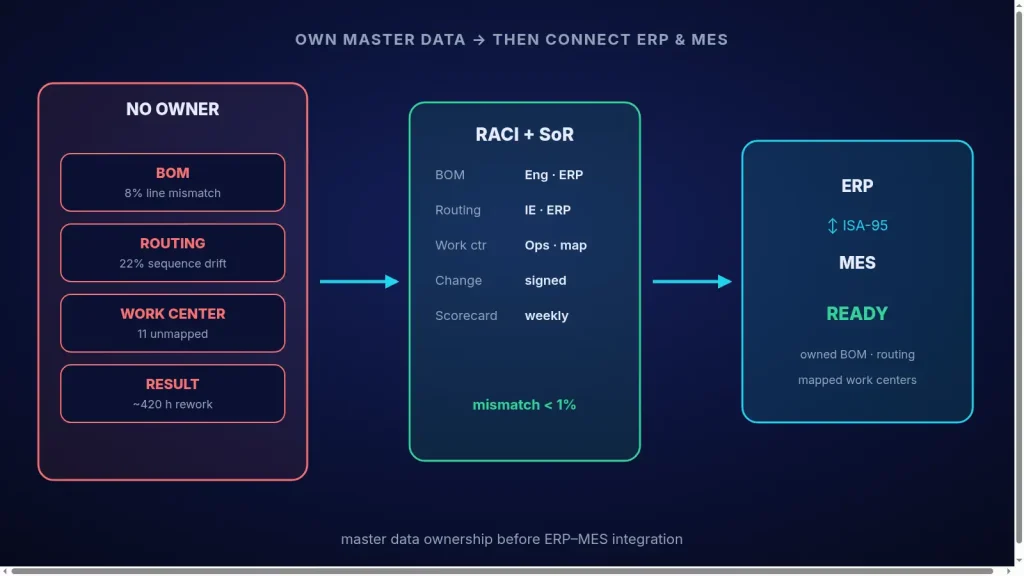
Why ERP–MES projects stall on master data
ISA-95 Level 4 (ERP) and Level 3 (MES/MOM) exchange production schedules, material definitions, equipment and performance feedback. The messages are well described. What is often missing is governance: which system is the system of record for each field, who may change it, and how the other side learns about the change.
- BOM lines diverge. Engineering releases a revision in PLM or ERP; the shop still runs yesterday’s pick list in MES. Scrap and “missing part” alarms rise for no process reason.
- Routings disagree on sequence or time. ERP capacity uses one standard time; MES dispatch uses another. Schedules look feasible on paper and fail on the line.
- Work centers do not map 1:1. ERP “WC-14” is three real stations in MES—or one MES line is split across two ERP cost centers. Every transfer report needs a manual map.
- No named owner. IT owns the interface; engineering owns the drawing; operations owns the line. Nobody owns the row that both systems must share.
If you are still aligning names and formulas across plants, my note on a KPI dictionary with one definition across plants is the same idea for metrics. For who should own capabilities on a map, see why enterprise architecture matters. Clean definitions also help when you later put numbers on a live operations dashboard.
Worked example: 1,200 BOM lines, silent mismatches (illustrative)
The numbers below are an illustrative example, not data from a real plant. They show how a small mismatch rate burns cash before anyone blames the interface.
A discrete plant is about to connect ERP and MES for one product family. Shared scope: 1,200 active BOM lines and 80 routings. A pre-integration extract compares ERP (system of record candidate) to MES (execution copy).
| Check (illustrative) | Count | Share |
|---|---|---|
| BOM lines compared | 1,200 | 100% |
| Part number or qty mismatch vs ERP | 96 | 8% |
| Unit-of-measure or scrap-factor mismatch | 36 | 3% |
| Routings with different operation sequence or std time | 18 of 80 | 22.5% |
| Work centers without a stable ERP↔MES map | 11 | — |
| Estimated rework / clarifying stops in first 90 days if you integrate anyway | ~420 planner–supervisor hours ≈ 10.5 person-weeks (at 40 h/week) | |
Assume each mismatched BOM line or routing causes about 3.5 hours of clarifying, re-picking or re-scheduling across planning and the line in the first quarter (illustrative average). Then 96 + 36 + 18 ≈ 150 issues × 3.5 h ≈ 525 hours—round down to ~420 after some overlap—and you have already spent more than two full-time months of scarce people on reconciliation. The interface tickets will say “data issue”. They are right. Fix ownership and the extract before you celebrate go-live.
Method: owner first, then the pipe
- RACI per master-data object. One row each for material/BOM header, BOM line, routing header, operation, work center / resource, and revision rule. Columns: Responsible (keeps the golden record), Accountable (signs changes), Consulted, Informed, and system of record (ERP, MES, PLM—or “ERP with MES read-only copy”).
- Simple master-data quality scorecard. Weekly, not a 40-column data-lake report. Example fields: % BOM lines with valid part + UoM; % routings with complete operation sequence; % work centers with a 1:1 map; open change requests older than 5 working days; last successful full reconcile date.
- Change-control flow. Propose → impact (which orders, which lines) → approve (Accountable) → publish to system of record → push or mark stale on the copy → acknowledge on the shop. No silent MES-only edits to shared fields.
- Pre-integration readiness checklist. Do not open the message pipe until: RACI signed, scorecard green on agreed thresholds, one full reconcile with mismatch log closed or waived in writing, and a rollback path for a bad revision.
What “good” looks like after ownership is clear
- ERP (or PLM) is system of record for engineering BOM and routing; MES holds an execution copy with a visible revision stamp.
- Every shared object has a RACI row and a change log (who, when, why).
- Mismatch rate on the weekly extract trends down and stays under the threshold you set before go-live.
- Interface errors are rare; when they appear, they point to a broken publish step—not to tribal edits on the line.
Enterprise architecture’s job here is unglamorous: name the data products and the owners so IT can build a boring, reliable sync. That is the same discipline as locking KPI definitions before you compare plants.
Checklist: master data before ERP–MES integration
- List the shared objects: BOM, routing, work center / resource, revision/effectivity.
- Write a one-page RACI with system of record per object; get Accountable names, not team labels only.
- Run a full ERP↔MES extract; log mismatches; clear or formally waive each class.
- Stand up a tiny quality scorecard and a change-control path that blocks silent dual edits.
- Agree go-live thresholds (e.g. BOM mismatch < 1%, every work center mapped).
- Only then enable the ISA-95-style exchanges for schedule, material and performance.
Want a short readiness pass before you integrate?
If your ERP and MES teams are about to sync BOMs and routings and nobody has signed a RACI yet, I can help you draft the object list, the scorecard and a realistic mismatch cleanup plan so go-live is about production—not about arguing which file is right.
Contact me Read: KPI dictionary across plants Read: why enterprise architecture matters
Sources
- ISA. ISA-95 (Enterprise-Control System Integration) — models and terminology for ERP / MES boundaries and information exchange.
- ISO/IEC. IEC 62264-1 (ISO/IEC 62264-1) — Enterprise-control system integration — Part 1: Models and terminology.
- ISO/IEC. IEC 62264-2 — Object model attributes for manufacturing operations management.