Many plants buy a full predictive-maintenance platform, hang dozens of sensors, and then drown in alerts—or they wait for a plant-wide AI programme that never starts. Meanwhile one critical machine keeps failing, and every unplanned stop costs more than a small, focused pilot would.
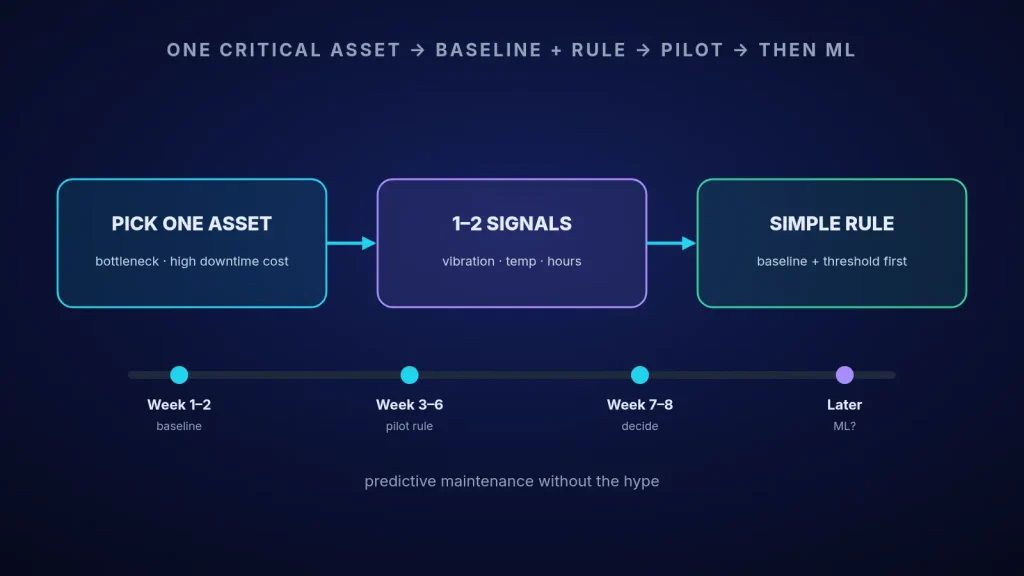
In my 24 years in manufacturing and industrial engineering I've seen both extremes: expensive dashboards nobody trusts, and plants that stay on calendar-based maintenance while a bottleneck compressor or press quietly destroys output. Predictive maintenance does not have to mean "AI everywhere". The practical path is almost boring: pick one critical asset, define the failure modes that actually hurt, measure one or two signals you already understand, set a baseline and a simple rule, and run a short pilot with a clear false-alarm budget.
Below is a concrete method, a worked example with illustrative numbers, and a checklist you can take to your next maintenance meeting.
More videos on my YouTube channel ↗
Why plant-wide PdM projects stall
Condition monitoring standards such as ISO 17359 start with cost–benefit, criticality and failure modes—not with buying every sensor on the catalogue. When teams skip that and jump to "AI PdM", three things usually go wrong:
- Too many assets at once. Alert volume rises faster than the team's ability to investigate, so people mute the system.
- Signals without a baseline. Without a period of known-good operation, every spike looks like a crisis.
- ML before a simple rule. If a temperature trend or vibration threshold already catches most failures, a model adds cost and opacity before you have proven the process.
The U.S. Department of Energy's Operations & Maintenance Best Practices Guide treats predictive maintenance as one programme type among several—useful when you can detect degradation early enough to plan the repair. That is exactly the bar for a one-asset pilot.
A practical method: one asset, then expand
- Pick one critical asset. Prefer a bottleneck machine, a single point of failure, or the asset with the highest downtime cost per hour. Write down why it is critical in one sentence.
- List failure modes that matter. Ignore exotic failures you have never seen. Focus on the two or three modes that caused unplanned stops in the last 12–24 months.
- Choose 1–2 measurable signals. Vibration, bearing temperature, motor current, runtime hours, scrap rate or cycle time—whatever already maps to those failure modes. Prefer signals you can collect reliably every shift.
- Build a baseline before any ML. Run 2–4 weeks of normal production and record typical ranges. Set an alert threshold or a simple trend rule (for example: rising 7-day average above baseline + X%). ISO 13374 describes the processing steps from acquisition to advisory; you do not need the full stack on day one—state detection and a clear advisory to maintenance is enough.
- Run a 4–8 week pilot with a false-alarm budget. Agree in advance how many false alerts per week are acceptable. Track true positives, false alarms, hours of downtime avoided, and hours spent investigating.
- Only then consider ML. If the simple rule already pays for itself, keep it. Add a model when you have labelled events, stable sensors and a maintenance owner who will act on predictions.
Worked example: a critical air compressor (illustrative)
The numbers below are an illustrative example, not data from a real plant. Replace them with your own.
| Item | Example value |
|---|---|
| Asset | Plant air compressor C-3 (bottleneck for two lines) |
| Unplanned downtime cost | $2,500 per hour (lost output + overtime; example) |
| Failures last 12 months | 4 bearing / overheat events |
| Average hours lost per failure | 6 hours |
| Annual downtime cost (example) | 4 × 6 × $2,500 = $60,000 |
| Signals for the pilot | Drive-end vibration (mm/s) + bearing housing temperature |
| Simple rule (before ML) | Alert if temp > baseline+15 °C for 20 min, or vibration RMS > 1.5× baseline |
| Pilot cost (sensors, logging, 6 weeks follow-up) | ≈ $4,000–$8,000 (example range) |
| Success bar for the pilot | Catch ≥2 events early enough to plan repair; ≤3 false alarms/week |
| If one 6-hour stop is avoided | ≈ $15,000 avoided vs pilot cost |
You do not need perfect prediction to win. Catching one failure a week early—ordering the bearing, scheduling the stop on Saturday—often pays for the pilot. If after eight weeks you have only noise, stop: either the signal is wrong for that failure mode, or the asset was the wrong first choice. That is still a useful result.
What "good" looks like after the pilot
- One named owner (maintenance or reliability) who reviews alerts every shift.
- A written baseline and thresholds stored next to the work order system—not only inside a vendor cloud.
- A short log: date, signal, action taken, true/false. This becomes training data if you later add ML.
- A decision: keep the rule, tighten it, change the signal, or expand to a second asset.
If you are comparing first AI projects more broadly, my article on applied AI use cases in manufacturing puts PdM next to quality, scheduling and document search. For messy process reality before you instrument anything, see also process mining from the event log. And if maintenance manuals are the bottleneck rather than sensors, a document assistant (RAG) pilot may free more time than another dashboard.
Checklist: one-asset predictive maintenance pilot
- One critical asset named, with downtime cost per hour estimated.
- Two or three failure modes that actually happened recently.
- One or two signals mapped to those modes; collection path agreed.
- Baseline from normal production; simple threshold or trend rule written down.
- False-alarm budget and success bar agreed with operations and maintenance.
- 4–8 week run with a daily/shift review owner.
- Log of true positives, false alarms and actions—before any ML discussion.
- Go / no-go decision on expanding or stopping.
Want help scoping the first asset?
If you have a bottleneck machine that keeps surprising you, or a PdM platform full of alerts nobody trusts, I can help you pick the first asset, define a baseline and a false-alarm budget, and design a short pilot that operations will actually follow.
Contact me Read: applied AI use cases Read: from spreadsheets to one live dashboard
Sources
- ISO. ISO 17359:2018 — Condition monitoring and diagnostics of machines — General guidelines.
- ISO. ISO 13374-1:2003 — Condition monitoring — Data processing, communication and presentation — Part 1: General guidelines.
- U.S. Department of Energy / PNNL. Operations & Maintenance Best Practices Guide, Release 3.0 (predictive maintenance chapter).